Navigate Global Geopolitical Risks with Strategic Clarity
Political tensions, trade restrictions, and regional conflicts increasingly shape investment outcomes.
Elite Strategy helps investors and corporate leaders anticipate geopolitical risks and design resilient global strategies.
Client Impact
30–50%
fewer strategic surprises from sanctions, regulatory changes, or political disruptions
2–3×
faster
board and executive decisions on international expansion and risk response
20–40%
reduction in supply-chain disruptions linked to geopolitical events
Geopolitics Has Become a Core Business Risk
Geopolitical developments now influence:
• supply chain stability
• energy prices
• investment regulations
• technology access
• international trade
For global companies and investors, geopolitical risk is no longer a distant policy issue — it is a daily operational challenge.
Companies expanding across Asia, Europe, and the Middle East must now plan for:
sanctions regimes
tariffs and trade restrictions
regional conflicts
regulatory divergence
national security reviews
Our geopolitical advisory practice helps leaders anticipate disruptions and design strategies that remain resilient across political scenarios.
Geopolitics Has Become a Core Business Variable
Geopolitical developments now influence strategic decisions across nearly every major industry.
Trade disputes, technology restrictions, sanctions regimes, and regional security tensions increasingly shape:
• global supply chain design
• energy and commodity prices
• market access and tariffs
• foreign investment approvals
• technology investment decisions
For companies operating across Asia, geopolitical developments can rapidly reshape the business environment.
Examples include:
• US–China technology competition
• semiconductor supply chain concentration
• shifting trade alliances across Asia
• geopolitical competition across maritime trade routes
Forward-looking organizations now integrate geopolitical analysis directly into corporate strategy, investment decisions, and operational planning.
Elite Strategy helps leadership teams anticipate geopolitical developments and translate uncertainty into strategic advantage.
OUR APPROACH
Turning Geopolitical Uncertainty into Strategic Advantage
We help organizations move beyond reactive risk management toward proactive geopolitical strategy.This approach enables leadership teams to make better strategic decisions under uncertainty.
Our advisory framework focuses on three priorities:

ANTICIPATE
Identify emerging geopolitical risks across Asia and global markets before they disrupt operations.

PREPARE
Develop strategic responses to geopolitical scenarios affecting supply chains, markets, and investments.

POSITION
Adapt corporate strategy and geographic footprint to remain competitive across shifting geopolitical environments.
Asia Geopolitical & Business Risk Dashboard
Top Strategic Risks for Business, Investment and Stability (2026–2028)
What Happens When Leaders Ignore Geopolitical Signals
Ignoring geopolitical dynamics does not eliminate risk.
It increases the probability of strategic surprise.
For companies operating internationally—particularly in Asia—geopolitics is increasingly shaping markets, supply chains, capital flows, and energy systems.
Leaders who fail to anticipate these shifts risk seeing their strategy overtaken by events.
Business Models Can Become Obsolete
Many industries were built during an era of accelerating globalization, integrated supply chains, and relatively stable geopolitical relations.
That environment is now evolving.
Strategic competition between the United States and China is reshaping technology ecosystems, trade relationships, and industrial policy. Over time, this rivalry could lead to partially separate technological, regulatory, and financial systems.
Companies positioned incorrectly within this divide may lose access to key markets, face regulatory barriers, or become caught between competing geopolitical blocs.
Business models designed for a unified global market may therefore require fundamental redesign.
Geography Is Becoming Strategically Important Again
For several decades, globalization encouraged companies to prioritize efficiency over geography.
That assumption is weakening.
Strategic chokepoints such as the Taiwan Strait, the South China Sea, and the Strait of Malacca illustrate how geopolitical tensions can directly affect:
• global shipping routes
• supply chain reliability
• energy transportation flows
A disruption in any of these areas could have immediate consequences for manufacturing, logistics, and commodity markets.
Supply chains optimized purely for cost efficiency may prove fragile in a world where strategic geography once again shapes economic outcomes.
Energy Security Is Returning as a Core Strategic Risk
Energy has re-emerged as one of the most powerful drivers of geopolitics.
Conflicts in the Middle East, tensions in the Indo-Pacific, and competition for critical minerals are increasingly influencing global energy markets.
Many Asian economies remain heavily dependent on imported energy transported through vulnerable maritime routes.
A disruption affecting oil or LNG flows—whether through conflict, sanctions, or maritime instability—could rapidly translate into:
• price shocks
• industrial disruption
• inflationary pressure
• reduced economic growth
For energy-intensive industries and investors, energy security risk is once again a strategic variable rather than a purely operational issue.
Governments Are Becoming Active Economic Players
Across Asia and the broader Indo-Pacific, governments are increasingly using economic policy as a strategic instrument.
Industrial policy, export controls, technology restrictions, investment screening, and strategic subsidies are now shaping global competition.
These developments reflect the rise of economic statecraft.
Companies operating internationally must therefore navigate not only markets, but also national strategic priorities.
In some sectors, competitive advantage may increasingly depend on geopolitical positioning and alignment with government policy.
The International Monetary System May Face New Pressures
The global financial system has long been anchored by the stability and dominance of the United States Dollar.
However, geopolitical tensions are raising questions about the future evolution of the international monetary order.
Several dynamics are contributing to this shift:
• geopolitical fragmentation of global trade
• increasing use of financial sanctions
• efforts by some countries to reduce reliance on dollar-based systems
• development of alternative payment networks and reserve diversification
While the dollar remains central to global finance, even partial fragmentation of the monetary system could reshape capital flows, trade settlement mechanisms, and financial stability.
For multinational companies and investors, currency architecture is becoming a geopolitical variable rather than purely a financial one.
Investors Are Pricing Geopolitical Exposure
Institutional investors increasingly incorporate geopolitical risk into capital allocation decisions.
Companies exposed to politically sensitive regions, strategic industries, or vulnerable supply chains may face:
• higher perceived risk
• valuation volatility
• higher costs of capital
Geopolitical awareness is therefore becoming a factor in enterprise valuation and long-term investment strategy.
Strategic Surprise Remains the Greatest Risk
The most damaging geopolitical events for companies are rarely gradual trends.
They are sudden shocks.
Examples could include:
• a crisis involving Taiwan
• escalation in the South China Sea
• instability linked to North Korea
• conflict affecting energy supply routes in the Middle East
Events that initially appear regional can quickly produce global economic consequences.
The real danger lies not simply in geopolitical tension, but in the speed with which geopolitical shocks can reshape the business environment.
Three Strategic Geopolitical Scenarios for 2030
Because geopolitical developments are inherently uncertain, strategic planning increasingly relies on scenario analysis.
Three broad trajectories could shape the global business environment over the coming decade.
Scenario 1 — Fragmented Globalization
Strategic rivalry between the United States and China intensifies, leading to a more divided global economic system.
Technology ecosystems, supply chains, and financial networks begin to separate into competing geopolitical blocs.
Key characteristics could include:
• regionalized supply chains
• competing technology standards
• increased trade restrictions
• strategic industrial policies
Companies operating globally would need to navigate parallel economic systems.
Scenario 2 — Managed Strategic Rivalry
Major powers continue to compete but avoid direct confrontation.
Economic interdependence remains significant, and global trade continues—though under greater political scrutiny.
Under this scenario:
• supply chains diversify rather than fragment
• geopolitical tensions remain manageable
• energy markets remain volatile but stable
• global investment continues with selective risk management
This environment would require continuous geopolitical monitoring but not fundamental restructuring of the global economy.
Scenario 3 — Global Systemic Shock
A major geopolitical crisis triggers rapid disruption across markets.
Possible catalysts could include:
• a major conflict involving Taiwan
• large-scale instability in the Middle East affecting global energy supply
• financial disruption affecting the international role of the United States Dollar
Such an event could rapidly disrupt:
• global supply chains
• financial markets
• energy prices
• international investment flows
For companies unprepared for geopolitical shocks, the consequences could be severe.
Why Business Leaders Seek Geopolitical Expertise
Most corporate leadership teams possess deep expertise in finance, operations, and markets.
Few organizations, however, maintain internal capabilities capable of systematically interpreting geopolitical developments.
Geopolitical dynamics involve the intersection of:
• international relations
• national security priorities
• economic policy
• regional political dynamics
• long-term strategic competition between states
Understanding how these forces interact—and how they may affect markets, investments, and supply chains—requires specialized expertise.
This is where geopolitical advisory becomes valuable.
How Specialized Geopolitical Advisory Supports Decision-Makers
Working with a geopolitical specialist allows leadership teams to move beyond reacting to headlines and instead develop structured foresight.
Effective advisory support can help organizations:
• anticipate geopolitical developments affecting their sector
• identify vulnerabilities in supply chains and energy exposure
• evaluate currency and financial system risks
• develop strategic scenarios for the next 5–10 years
• assess political and regulatory risk before entering new markets
• protect investments from geopolitical shocks
For CEOs, boards, and investors, geopolitical intelligence becomes a strategic decision tool—not simply a risk report.
From Uncertainty to Strategic Advantage
Organizations that integrate geopolitical intelligence into their strategy gain a critical advantage.
They anticipate change rather than react to it.
In an increasingly complex global environment—especially across Asia—geopolitical awareness is becoming essential for leaders responsible for long-term growth and resilience.
Companies that treat geopolitical foresight as part of their strategic toolkit are better positioned to:
• protect operations
• safeguard investments
• anticipate disruption
• identify emerging opportunities
In a world where geopolitics increasingly shapes markets, energy security, capital flows, and supply chains, leaders who understand the strategic landscape of Asia will be better prepared to protect their business—and seize opportunities others may miss.
What Happens When Leaders Ignore Geopolitical Signals
Ignoring geopolitical dynamics does not eliminate risk.
It increases the probability of strategic surprise.
For companies operating internationally—particularly across Asia—geopolitics is increasingly shaping markets, supply chains, capital flows, and energy systems.
Decisions once considered purely commercial—where to invest, how to structure supply chains, which markets to prioritize—are now increasingly influenced by strategic competition between states.
Leaders who fail to anticipate these shifts risk seeing their strategy overtaken by events.
-
Many industries were built during an era of accelerating globalization, integrated supply chains, and relatively stable geopolitical relations.
That environment is now evolving.
Strategic competition between the United States and China is already reshaping technology ecosystems, industrial policy, and global trade relationships.
Over time, this rivalry could produce parallel economic and technological systems, with different standards, regulations, and strategic alliances.
Companies positioned incorrectly within this divide may lose access to major markets or face regulatory restrictions on technology, investment, or supply chains.
Business models designed for a fully integrated global market may therefore require fundamental redesign.
-
For several decades, globalization encouraged companies to prioritize efficiency over geography.
That assumption is weakening.
Strategic chokepoints such as the Taiwan Strait, the South China Sea, and the Strait of Malacca illustrate how geopolitical tensions can directly affect:
• global shipping routes
• supply chain reliability
• energy transportation flowsA disruption affecting any of these routes could rapidly affect global manufacturing, trade, and commodity markets.
Supply chains optimized purely for cost efficiency may prove fragile in a world where strategic geography once again shapes economic outcomes.
-
Energy is once again becoming a central dimension of geopolitics.
Conflicts in the Middle East, tensions in the Indo-Pacific, and competition over critical minerals are increasing the geopolitical sensitivity of global energy markets.
Many Asian economies remain highly dependent on imported energy transported through vulnerable maritime routes.
A disruption affecting oil or LNG flows—whether caused by military conflict, sanctions, or maritime instability—could rapidly produce:
• price shocks
• industrial disruption
• inflationary pressure
• reduced economic growthFor many sectors—from manufacturing to logistics—energy security is becoming a strategic risk that can shape long-term competitiveness.
-
The most damaging geopolitical events for companies are rarely gradual trends.
They are sudden shocks.
Examples could include:
• a crisis involving Taiwan
• military escalation in the South China Sea
• instability linked to North Korea
• conflict affecting energy supply routes in the Middle EastEvents that initially appear regional can quickly produce global economic consequences.
The greatest danger for companies is not simply geopolitical tension—it is the speed with which geopolitical shocks can transform the business environment.
-
Across Asia and the broader Indo-Pacific, governments are increasingly using economic policy as a strategic instrument.
Industrial policy, export controls, technology restrictions, investment screening, and strategic subsidies are reshaping global competition.
This reflects the rise of economic statecraft, where national governments actively shape economic outcomes in strategic industries.
Companies operating internationally must therefore navigate not only markets, but also national strategic priorities.
In certain sectors—technology, energy, infrastructure, and defense-related industries—competitive advantage may increasingly depend on geopolitical positioning.
-
For decades, the global financial system has been anchored by the stability and dominance of the United States Dollar.
However, growing geopolitical tensions are raising questions about the long-term evolution of the international monetary system.
Several developments are contributing to this debate:
• geopolitical fragmentation of global trade
• the increasing use of financial sanctions
• efforts by some countries to reduce dependence on dollar-based payment systems
• the development of alternative financial infrastructureWhile the dollar remains central to global finance, even partial fragmentation of the international monetary systemcould reshape global capital flows, trade settlement, and financial stability.
For multinational companies and investors, currency architecture is becoming a geopolitical variable rather than purely a financial one.
-
Institutional investors increasingly integrate geopolitical risk into their capital allocation decisions.
Companies exposed to politically sensitive regions, strategic industries, or vulnerable supply chains may face:
• higher perceived risk
• greater valuation volatility
• increased cost of capitalGeopolitical awareness is therefore becoming a factor in enterprise valuation and long-term investment strategy.
How One Asian Manufacturer Turned Geopolitical Insight into Competitive Advantage
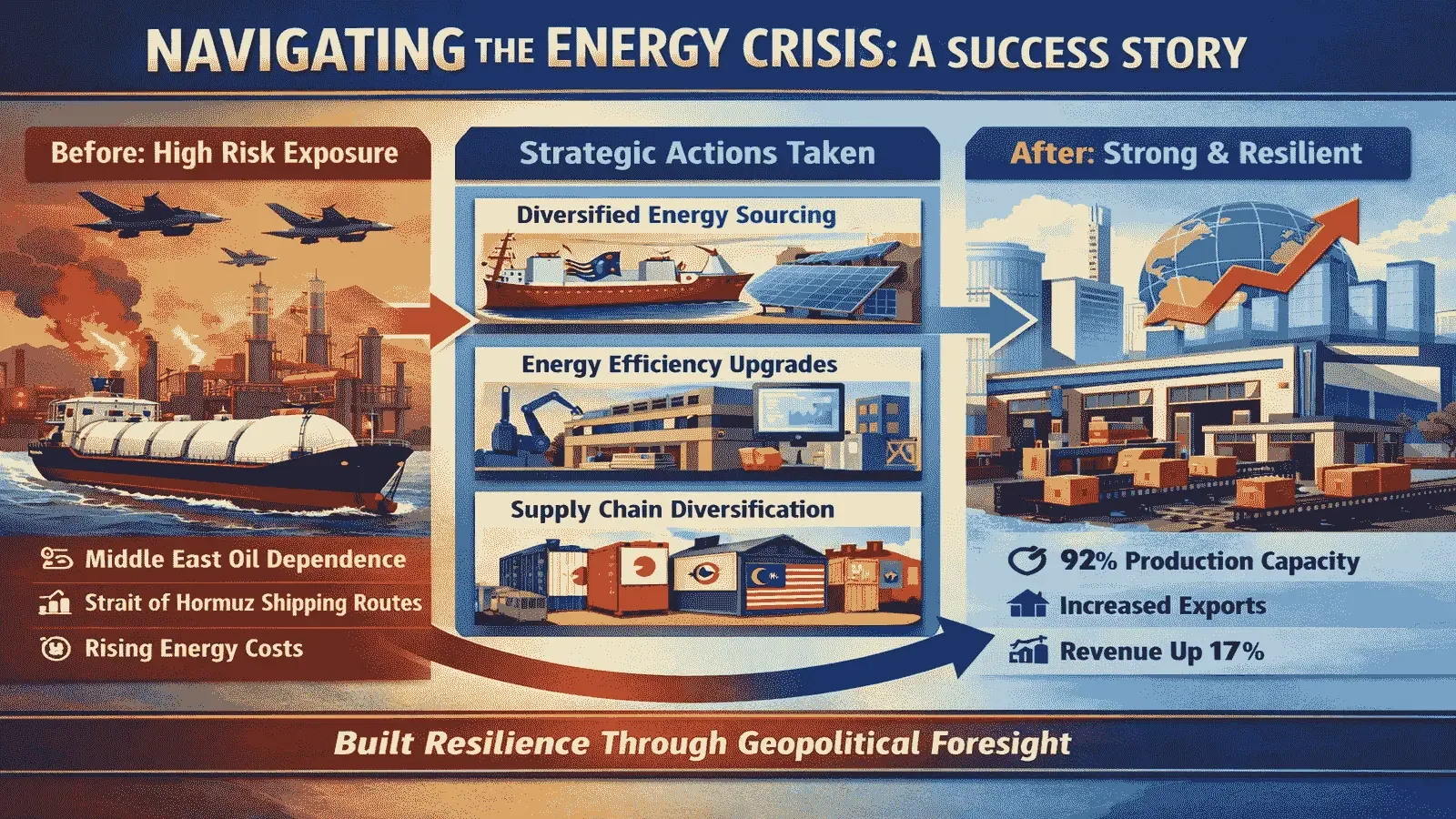
The Situation (2024)
A mid-size industrial manufacturer based in Singapore operated factories across Vietnam and Thailand.
Their business model depended on:
petrochemical inputs derived from Middle East oil
shipping routes through the Strait of Hormuz
diesel-powered regional logistics
Energy represented 28% of total operating costs.
At the time, executives believed geopolitical tensions in the Middle East were temporary political noise.
But the company decided to commission a geopolitical risk assessment to evaluate exposure to future disruptions.
Read more →
ANTICIPATE GEOPOLITICAL DISRUPTION IN ASIA
Work with a geopolitical advisor to understand emerging risks across Asia, safeguard your operations, and position your organization to adapt in one of the world’s most dynamic and strategically contested regions.
From supply chain shifts to energy security and regional power competition, geopolitical developments across Asiaincreasingly shape business stability and market access.
Through strategic insight and forward-looking analysis, I help leaders anticipate disruption, protect critical operations, and make confident decisions in an increasingly uncertain regional environment.
We work with ambitious leaders who want to define the future, not hide from it. Together, we achieve extraordinary outcomes.