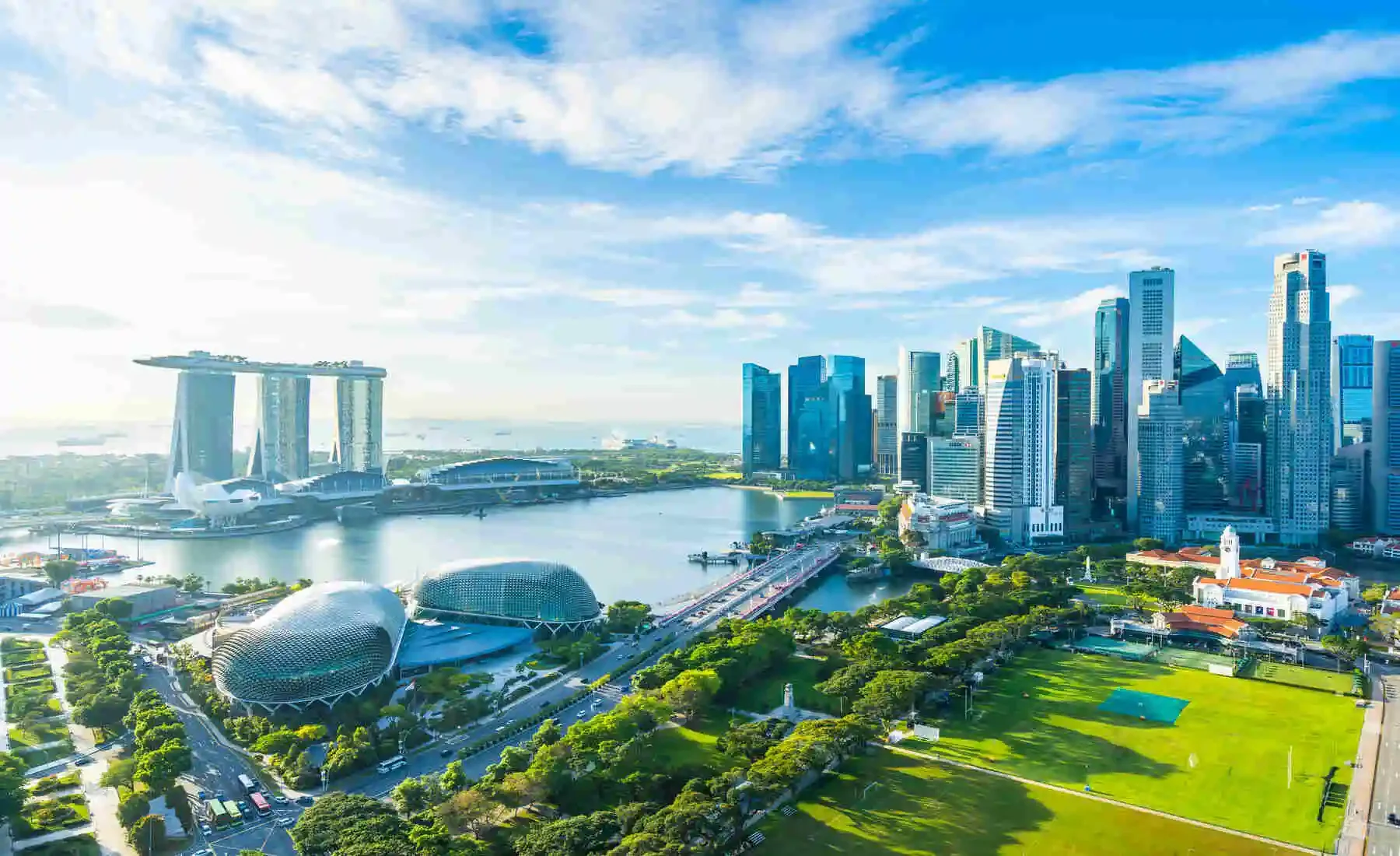
For decades, global companies structured their international operations around a few major financial centers.
Hong Kong anchored Asia.
Dubai connected the Middle East and global capital flows.
London and New York coordinated Western markets.
Today that architecture is shifting.
Geopolitical tensions, regional conflicts and rising strategic uncertainty are forcing leadership teams to reconsider where they anchor operations, capital and decision-making.
In this new environment, one city is increasingly emerging as a safe strategic command center for Asia.
Singapore.

Geopolitics Is Reshaping Corporate Geography
Over the past decade, global corporations have faced a series of geopolitical shocks.
Changes in Hong Kong’s political environment after the introduction of the Hong Kong National Security Law prompted some firms to diversify their regional headquarters strategy.
More recently, the escalating conflict involving Iran has raised new concerns for companies operating across the Gulf.
Missile and drone attacks linked to the conflict have targeted infrastructure and financial centers in the United Arab Emirates, including Dubai, forcing some banks to suspend operations or close branches temporarily.
The broader regional instability is already influencing capital flows.
Some Asian entrepreneurs and investors have begun transferring assets from Dubai to financial centers such as Singaporein order to reduce geopolitical exposure.

The Iran Conflict and the Reassessment of Middle East Risk
The conflict surrounding Iran has already disrupted key economic corridors.
Shipping routes and logistics networks across the Gulf have become increasingly uncertain as tensions escalate around strategic waterways such as the Strait of Hormuz, a passage that carries roughly one-fifth of global oil trade.
The implications for multinational corporations are significant.
Companies coordinating operations across Europe, the Gulf and Asia are now actively reassessing:
operational security
travel restrictions for executives
supply chain continuity
capital allocation exposure
For many organizations, the result is not a complete exit from the Middle East, but rather a diversification of strategic command centers.
Singapore is increasingly benefiting from that shift.
Why Singapore Is Emerging as Asia’s Strategic Safe Hub
Singapore offers a rare combination of attributes that are increasingly valuable in a fragmented geopolitical landscape.
Political Neutrality
Singapore maintains strong relationships across major global powers while remaining politically stable.
Financial Infrastructure
It is one of the world’s most sophisticated financial centers, connecting capital flows between Asia, Europe and the United States.
Regional Accessibility
Within a few hours of flight time, executives can reach key markets including:
Shanghai
Tokyo
Seoul
Jakarta
This connectivity allows leadership teams to coordinate complex multi-country strategies from a single location.

The Rise of the Multi-Hub Global Corporation
In response to geopolitical uncertainty, many companies are shifting toward multi-hub operating structures.
Instead of relying on a single global headquarters, organizations now distribute strategic leadership across multiple regions.
A typical model increasingly looks like this:
New York or London for global finance
Dubai for Middle East access
Singapore for Asia-Pacific strategy
This approach allows companies to balance geopolitical risk while maintaining proximity to major growth markets.
Strategic Implications for Leadership Teams
For corporate leaders, geography is no longer simply an operational choice.
It is a strategic decision influenced by geopolitics, capital flows and global security dynamics.
Singapore’s stability, neutrality and global connectivity have positioned it as one of the most resilient strategic hubs in the global economy.
As geopolitical fragmentation accelerates, more multinational companies are likely to anchor regional strategy there.
Singapore’s Strategic Moment
The global business map is being quietly redrawn.
As tensions reshape financial hubs from Hong Kong to the Gulf, companies are seeking locations that combine stability, connectivity and strategic neutrality.
Singapore increasingly sits at the center of that equation.
For leadership teams navigating an uncertain geopolitical landscape, it is becoming one of the most important places in the world to design and coordinate Asia strategy.
Strategic Advisory
We advise leadership teams structuring growth and expansion across Singapore, Taiwan, Greater China, Japan and Korea.
Discuss your strategic priorities with our advisory team.