PUBLIC AI MOMENTUM IS ACCELERATING — BUT ENTERPRISE-WIDE RESULTS REMAIN ELUSIVE

Across Asia, AI investment has moved from experimentation to boardroom priority.
From Seoul to Singapore, Tokyo to Ho Chi Minh City, leadership teams are facing increasing pressure to demonstrate that artificial intelligence can generate measurable business value. Investors expect productivity gains. Boards expect transformation. Competitors are publicly announcing ambitious AI initiatives.
Yet beneath the headlines, a different reality is emerging.
Many organizations are investing heavily in AI while struggling to identify clear enterprise-wide returns.
The challenge is no longer deciding whether AI matters.
The challenge is determining how AI creates measurable strategic value inside complex organizations operating under increasingly difficult economic, geopolitical, and operational conditions.
THE ASIA AI VALUE GAP
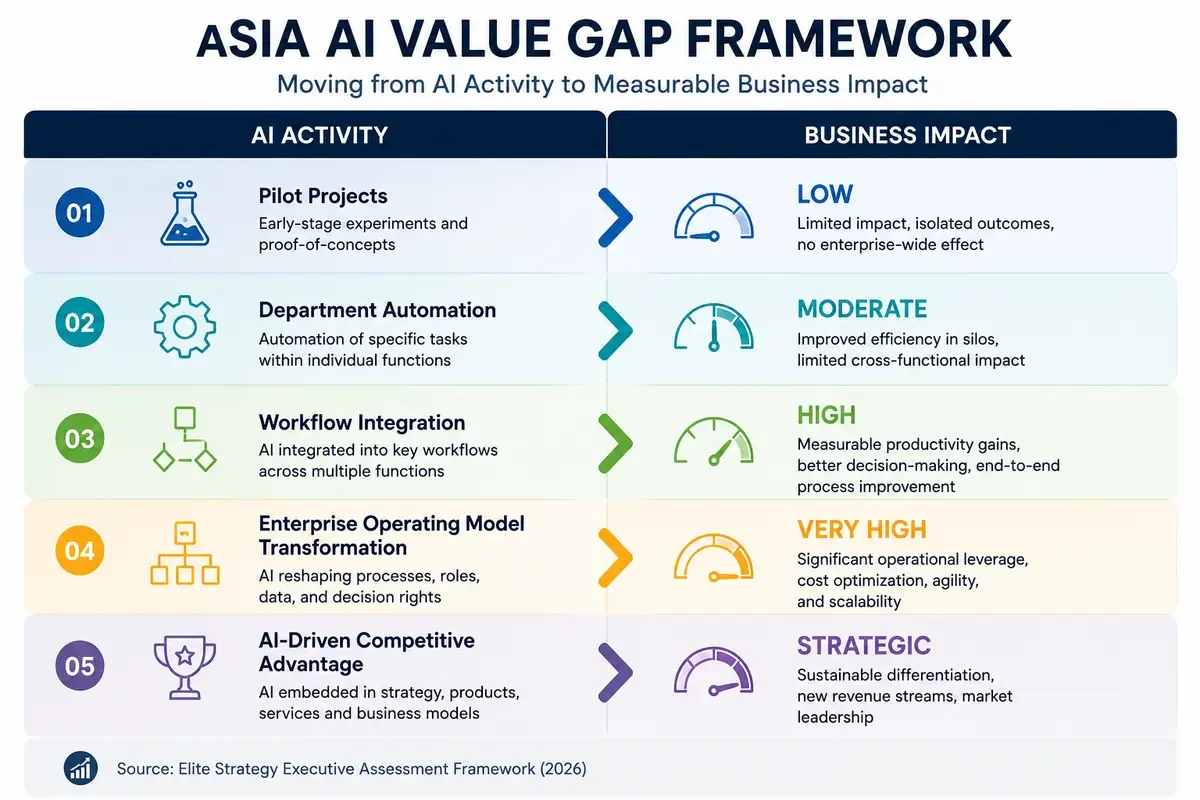
One pattern is becoming increasingly visible across Asian markets.
Most companies are generating AI activity.
Far fewer are generating AI transformation.
Across executive discussions conducted throughout Korea, Southeast Asia, and broader Asia, a recurring pattern has emerged:
Organizations often measure AI success through deployment metrics rather than business outcomes.
Questions frequently focus on:
How many AI projects have launched?
How many employees use AI tools?
How many processes have been automated?
Far less attention is given to the metrics that ultimately matter:
Revenue growth
Productivity improvement
Cost reduction
Decision speed
Customer retention
Market responsiveness
This creates what Elite Strategy refers to as the AI Value Gap—the growing distance between AI activity and measurable business impact.
EXECUTIVE OBSERVATIONS FROM ASIA (2025–2026)
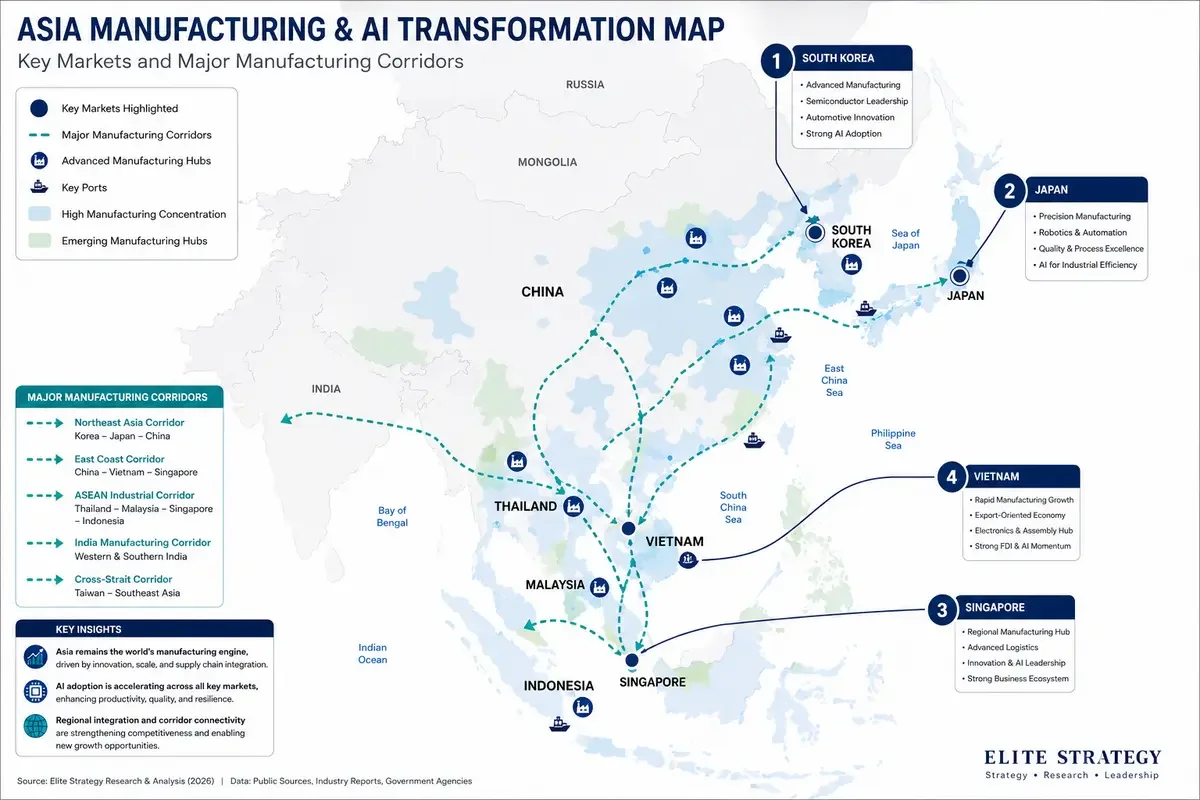
Based on ongoing executive discussions throughout Asia, several recurring patterns are becoming apparent.
Observation 1: Technology Is Moving Faster Than Organizations
Many enterprises can deploy AI tools relatively quickly.
What proves far more difficult is redesigning operating models, workflows, governance structures, and decision-making processes to take advantage of those tools.
Technology implementation often takes months.
Organizational adaptation frequently takes years.
Observation 2: Productivity Gains Are Easier Than Strategic Gains
Most organizations achieve initial productivity improvements.
Far fewer successfully create new revenue streams, strengthen competitive positioning, or establish durable market advantages through AI.
This distinction is critical.
Productivity can be copied.
Strategic advantage is considerably harder to replicate.
Observation 3: Leadership Alignment Remains the Largest Constraint
The most significant barriers to AI success are often not technical.
They are organizational.
Conflicting priorities, unclear ownership, fragmented governance, and inconsistent executive sponsorship frequently create greater obstacles than the technology itself.
WHY ASIA FACES UNIQUE AI CHALLENGES

Asia presents a more complex environment for AI transformation than many Western markets.
Leadership teams must simultaneously manage:
Regional supply chain complexity
Manufacturing dependencies
Workforce transitions
Cross-border operations
Regulatory fragmentation
Geopolitical uncertainty
Digital infrastructure disparities
For many organizations, AI strategy cannot be separated from broader operational strategy.
An AI initiative that succeeds in one market may face entirely different implementation challenges elsewhere in Asia.
This is why generic AI transformation models often fail when applied across the region.
THE COMPANIES WINNING WITH AI ARE ASKING DIFFERENT QUESTIONS
A growing divide is beginning to emerge.
Many organizations continue asking:
Which AI tools should we adopt?
The highest-performing organizations are increasingly asking:
Which business problems should AI solve?
This distinction appears subtle but has major implications.
Successful organizations typically begin with strategic objectives and then identify where AI creates value.
Less successful organizations often begin with technology and attempt to discover value afterward.
The difference can determine whether AI becomes a competitive advantage or simply another operational expense.
THE ELITE STRATEGY AI PRESSURE MAP
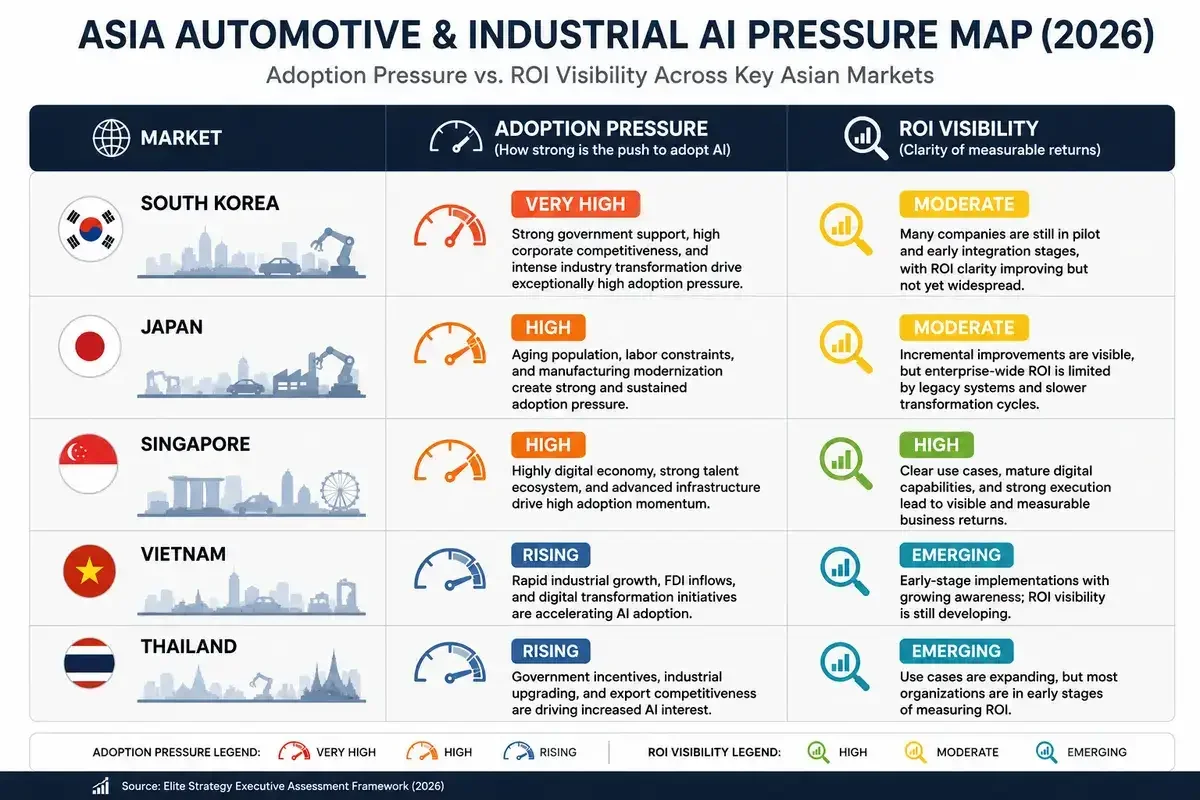
Executive assessment based on regional market observations and industry engagement.
The pressure to adopt AI is increasing everywhere.
The visibility of returns is not.
This imbalance is becoming one of the defining strategic challenges facing leadership teams across Asia.
THE REAL QUESTION LEADERS SHOULD BE ASKING
The future winners of AI adoption may not be the organizations investing the most capital.
They may be the organizations demonstrating the greatest strategic discipline.
Leadership teams should increasingly focus on six questions:
Where does AI create measurable business value?
Which functions should be prioritized first?
How should workforce structures evolve?
What governance mechanisms are required?
How will operating models change?
How will AI strengthen long-term competitiveness?
These are not technology questions.
They are leadership questions.
And as AI adoption accelerates across Asia, the organizations that answer them effectively will be significantly better positioned to convert technological potential into sustainable enterprise value.
Executive Conclusion
The next phase of AI competition in Asia will not be defined by access to technology.
Technology is increasingly available to everyone.
The next phase will be defined by strategic clarity, operational integration, and leadership execution.
Organizations that treat AI as a business transformation challenge rather than a technology deployment exercise are likely to capture disproportionate value over the coming decade.
For many leadership teams across Asia, that distinction may become one of the most important strategic decisions they make.