EXECUTIVE RESPONSIBILITIES ARE EXPANDING — BUT STRATEGIC VISIBILITY IS OFTEN DECLINING

Across Korea and Asia, many CEOs are operating in an environment that feels fundamentally different from even a few years ago.
Markets move faster.
Competition emerges from unexpected directions.
Technology continues to reshape entire industries.
Investors demand greater performance visibility.
Boards expect stronger governance.
Employees expect more leadership engagement.
At the same time, organizations themselves are becoming increasingly complex.
More systems.
More data.
More reporting.
More stakeholders.
More strategic initiatives.
More uncertainty.
Yet despite working longer hours, attending more meetings, reviewing more reports, and managing more responsibilities than ever before, many executives are confronting a growing concern:
They feel less certain about what is truly happening inside their organizations.
For many leadership teams, the challenge is no longer a lack of information.
The challenge is maintaining strategic control amid overwhelming complexity.
This is becoming one of the defining executive pressures facing organizations across Asia.
EXECUTIVE OBSERVATIONS FROM ASIA'S LEADERSHIP TEAMS (2025–2026)
Across our work with executive teams throughout Korea and Asia, a consistent pattern has emerged.
Most CEOs are not suffering from a lack of information.
They are struggling with information overload.
Leadership teams are receiving more reports, more analytics, more dashboard updates, and more AI-generated insights than at any point in the past decade.
Yet many executives report feeling less certain about organizational alignment, execution progress, and strategic readiness than they did before digital transformation accelerated.
The challenge is increasingly becoming one of visibility rather than access.
As organizational complexity expands faster than leadership capacity to absorb information, maintaining a clear enterprise-wide view is becoming a strategic discipline in itself.

THE EXPLOSION OF INFORMATION IS NOT CREATING MORE CLARITY
Most organizations today generate enormous amounts of information.
Performance dashboards.
Financial reports.
Customer analytics.
Market intelligence.
Risk assessments.
Operational metrics.
AI-generated insights.
Competitive monitoring.
In theory, leadership teams should have greater visibility than ever before.
In practice, many CEOs are experiencing the opposite.
The sheer volume of information has become so extensive that distinguishing meaningful signals from background noise is becoming increasingly difficult.
Leaders often spend significant time reviewing reports without gaining proportional increases in strategic understanding.
The result is a growing paradox inside many organizations:
More information.
But less clarity.
More reporting.
But less visibility.
More analysis.
But less confidence.
Executives remain informed, yet many no longer feel fully in control.
THE EXECUTIVE VISIBILITY GAP
Many CEOs are experiencing what can be described as an Executive Visibility Gap.
This occurs when the volume of information available to leadership grows faster than the organization's ability to convert that information into actionable strategic understanding.
The symptoms are often subtle:
Leadership teams review more reports but gain fewer insights.
Decision cycles become longer despite increased access to data.
Strategic priorities become harder to communicate across the organization.
Multiple initiatives compete for resources without clear enterprise-wide alignment.
Executives spend more time managing information and less time shaping direction.
The larger the organization becomes, the greater the risk that visibility declines even as information expands.

ACTIVITY IS INCREASING FASTER THAN STRATEGIC ALIGNMENT
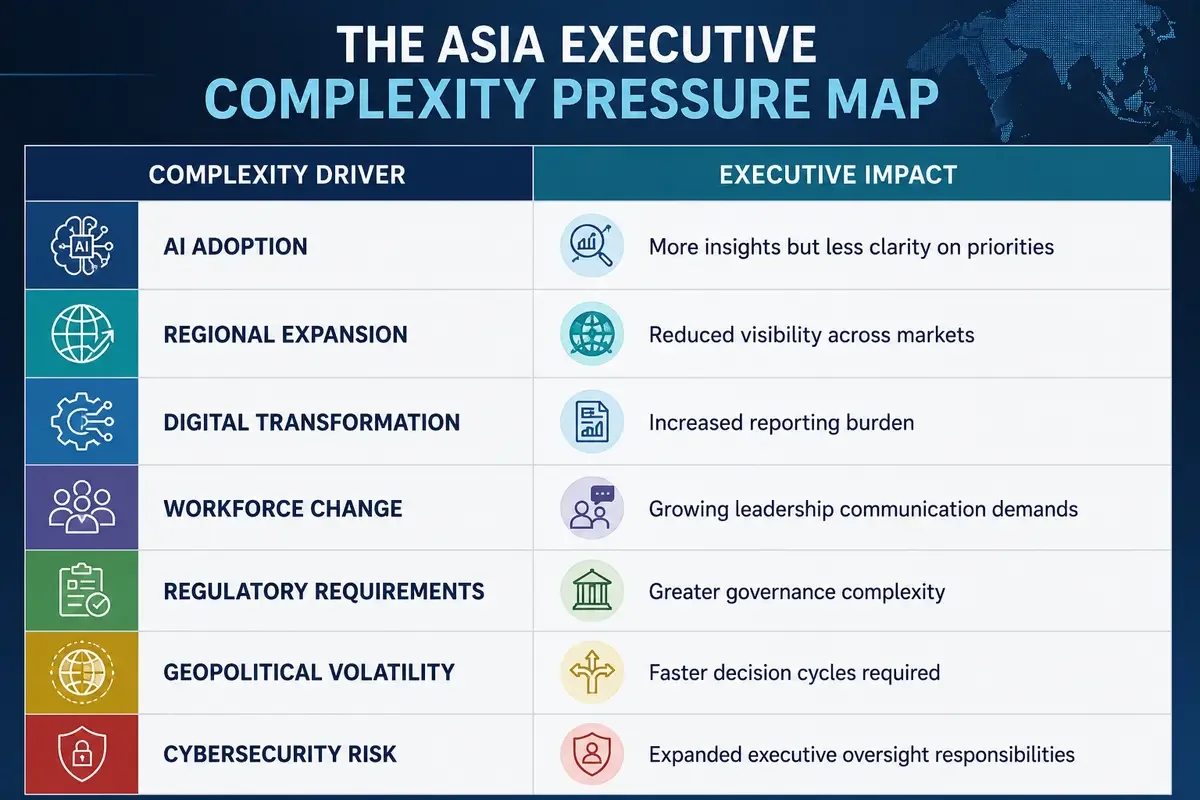
At the same time, leadership teams are facing an expanding list of priorities competing for executive attention.
Many organizations are simultaneously attempting to:
Accelerate digital transformation
Integrate AI capabilities
Improve productivity
Reduce costs
Expand into new markets
Strengthen cybersecurity
Manage workforce challenges
Satisfy investor expectations
Respond to regulatory change
Navigate geopolitical uncertainty
Individually, many of these priorities are valid.
Collectively, they can create significant organizational strain.
As initiatives multiply, leadership attention becomes increasingly fragmented.
Meetings increase.
Committees expand.
Reporting requirements grow.
Decision cycles become slower.
Strategic priorities become less clear.
Organizations often become highly active while gradually losing alignment around their most important objectives.
This creates one of the most dangerous executive illusions:
A company can appear busy, productive, and engaged while strategic momentum quietly deteriorates beneath the surface.
THE COST OF LOSING STRATEGIC CONTROL
When CEOs begin losing visibility into organizational priorities, the consequences often extend far beyond operational inefficiency.
Strategic control influences nearly every aspect of enterprise performance.
Decision quality declines.
Resources become dispersed across competing initiatives.
Investment priorities become less disciplined.
Execution slows.
Internal alignment weakens.
Organizational confidence erodes.
Over time, leadership teams may find themselves spending more energy managing complexity than shaping future direction.
This challenge becomes particularly significant during periods of economic uncertainty.
When external conditions become unstable, organizations require faster decisions, clearer priorities, and stronger strategic discipline.
Unfortunately, these are often the exact periods when complexity accelerates.
For many executives, maintaining control is becoming less about authority and more about visibility, focus, and alignment.
WHY MANY CEOS ARE STRUGGLING TO SEE THE WHOLE PICTURE
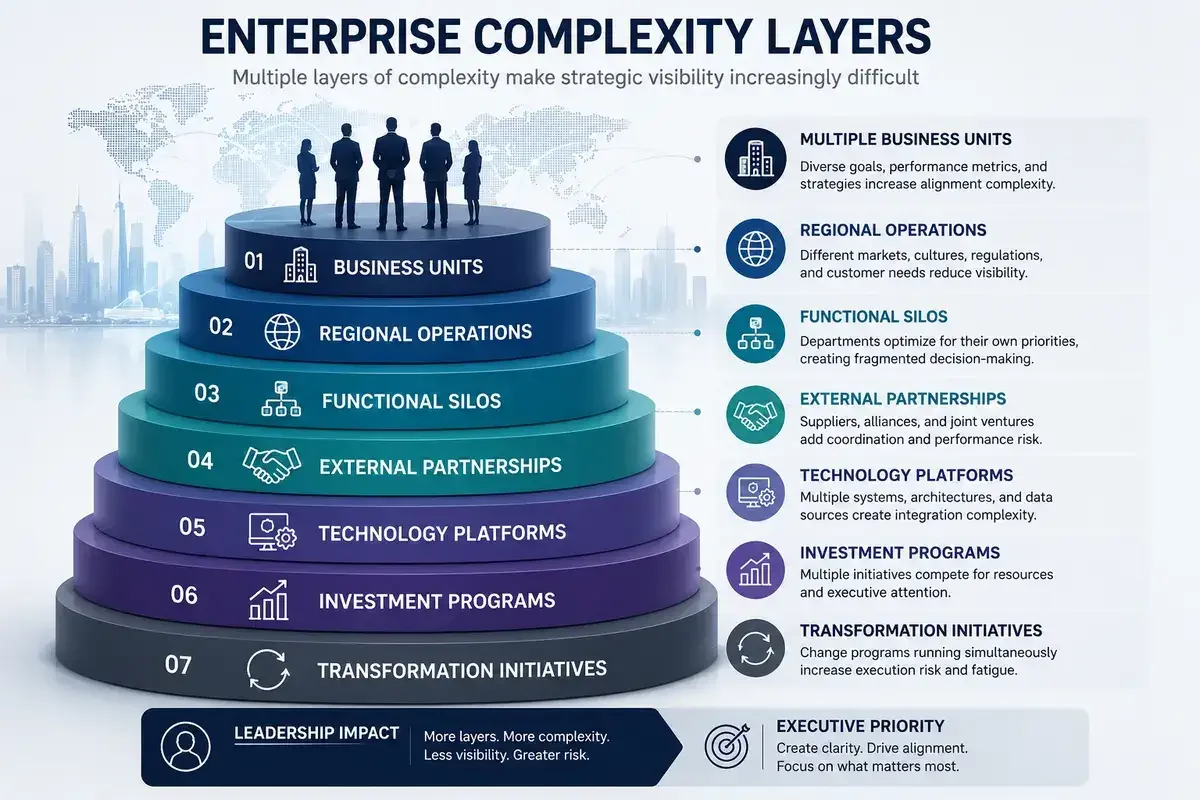
As organizations grow, visibility naturally becomes more difficult.
Multiple business units.
Regional operations.
Functional silos.
External partnerships.
Technology platforms.
Investment programs.
Transformation initiatives.
Each layer adds complexity.
Many leadership teams discover that while operational data continues to increase, understanding how individual decisions affect the broader enterprise becomes increasingly difficult.
This creates a critical leadership risk.
Executives may optimize individual functions while losing sight of enterprise-wide priorities.
They may improve short-term performance while weakening long-term competitiveness.
They may focus on urgent issues while neglecting strategic realities that ultimately determine future success.
The challenge is not a lack of intelligence.
The challenge is maintaining enterprise-wide perspective in increasingly fragmented environments.
WHERE THE VISIBILITY CHALLENGE IS MOST SEVERE
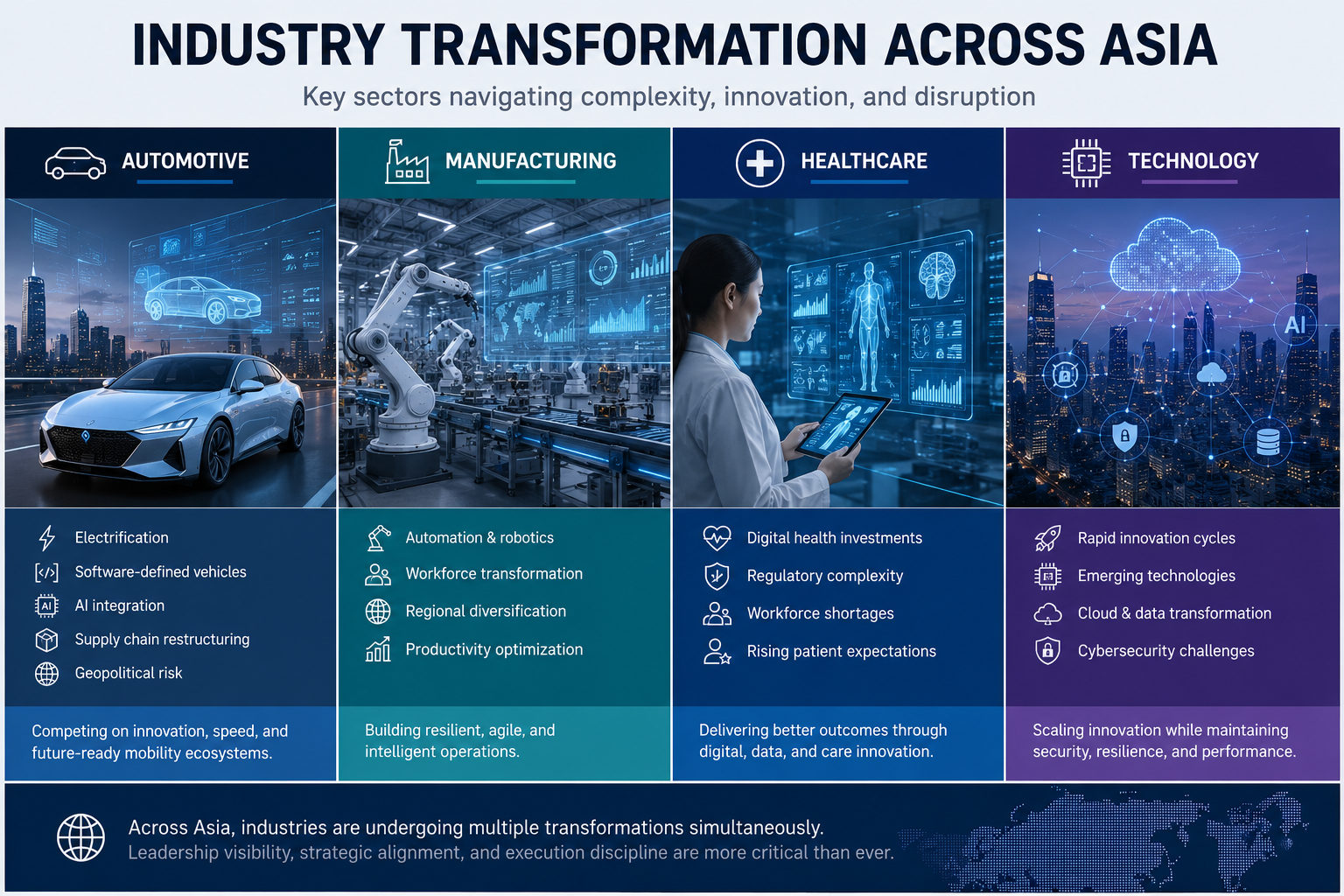
While nearly every sector is experiencing growing complexity, several industries across Asia are facing particularly intense visibility pressures.
Automotive
Organizations are simultaneously managing electrification, software-defined vehicles, AI integration, supply chain restructuring, and geopolitical risk.
Manufacturing
Leaders must balance automation initiatives, workforce transformation, regional diversification, and productivity targets.
Technology
Rapid innovation cycles create constant pressure to evaluate emerging technologies while maintaining operational discipline.
Healthcare
Executives face expanding regulatory requirements, digital health investments, workforce shortages, and increasing patient expectations.
In each case, leadership teams are attempting to navigate multiple transformations simultaneously.
THE MOST EFFECTIVE CEOS ARE SIMPLIFYING, NOT EXPANDING
Some of the strongest leadership teams are responding differently.
Rather than continuously adding new initiatives, they are becoming more disciplined about prioritization.
Rather than increasing reporting requirements, they are focusing on a smaller number of indicators that genuinely influence decision-making.
Rather than pursuing every opportunity, they are concentrating resources on areas most closely aligned with long-term strategy.
This approach is becoming increasingly important.
The future competitive advantage of many organizations may not come from having more information, more dashboards, or more initiatives.
It may come from maintaining clarity while competitors become overwhelmed by complexity.
The ability to simplify, prioritize, and align may become one of the most valuable executive capabilities of the coming decade.
CLARITY MAY BECOME THE NEXT COMPETITIVE ADVANTAGE
For decades, organizations competed through scale.
Then they competed through efficiency.
More recently, they competed through digital capability.
The next leadership advantage may be something far simpler.
Clarity.
The ability to identify what matters most.
The discipline to prioritize effectively.
The visibility to understand how decisions affect the broader enterprise.
And the focus to maintain strategic alignment amid growing complexity.
Across Korea and Asia, organizations are entering a period where complexity will continue to increase.
The leaders who succeed may not be those with the most information.
They may be those who can see most clearly through it.