What France can teach companies about debt, taxation, investment and the cost of indecision

France is the case study.
The company is the mirror.
France is one of the most heavily taxed advanced economies in the world. Its tax-to-GDP ratio reached 43.5% in 2024, among the highest in the OECD.
Yet the country continues to run large public deficits and accumulate debt.
Public spending remains exceptionally high. Redistribution is extensive. Support programmes, tax expenditures and subsidies are deeply embedded in the economy.
And still, the financial equation remains difficult.
This is not primarily a political question.
It is a strategic question.
Because the same dynamic can happen inside a company.
Costs increase.
Growth slows.
Debt accumulates.
Margins become harder to protect.
Every cost has a reason.
Every business unit has a history.
Every subsidy or support programme has a beneficiary.
Every restructuring creates resistance.
And management begins postponing the decisions that would change the underlying economics.
Nothing necessarily collapses.
At first.
That is what makes the situation dangerous.
THE MIRROR EFFECT

A country is obviously not a company.
Governments provide public services, redistribute income and manage objectives that cannot be measured like a corporate P&L.
But the underlying strategic principle is surprisingly similar.
A company can also reach a point where:
costs are structurally high;
growth is insufficient;
debt is increasing;
capital becomes less productive;
legacy activities consume resources;
subsidies or internal support hide weak economics;
difficult decisions are repeatedly postponed.
The organisation may still look stable.
Revenue may still be substantial.
The brand may still be strong.
Employees may still be busy.
Customers may still be loyal.
But the question changes.
It is no longer:
“Are we doing well?”
It becomes:
“Are we becoming better or worse at generating returns on the next euro we invest?”
That is the strategic mirror.
THE PROBLEM IS NOT ONE COST
Companies rarely become uncompetitive because of one expense.
The problem is usually cumulative.
A little more taxation.
A little more regulation.
Higher salaries.
Higher energy.
Higher financing costs.
Higher logistics costs.
More management layers.
More compliance.
More working capital.
More support required by underperforming activities.
Individually, each increase may be manageable.
Together, they change the economics of the business.
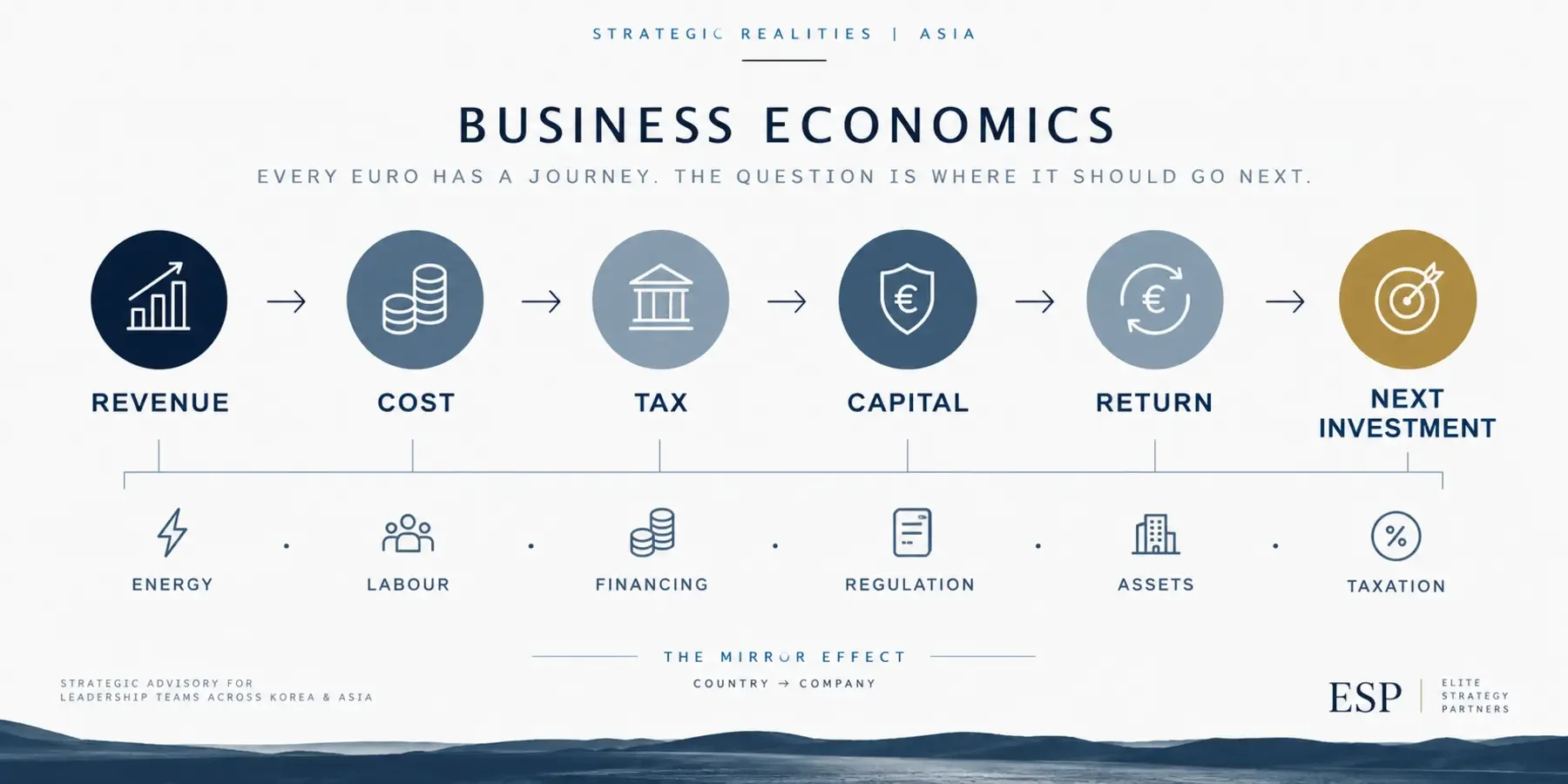
This is also why simply looking at revenue can be misleading.
A company can grow revenue while becoming strategically weaker.
The important number is not always:
How much did we sell?
It can be:
How much return are we generating on the capital required to produce the next unit of growth?
FRANCE IS AN INTERESTING CASE STUDY
France illustrates this tension particularly well.
The country combines a very high level of taxation and public expenditure with persistent deficits and rising public debt.
The European Commission projects French public debt to continue rising through 2027, while economic growth remains relatively modest.
For business leaders, the interesting point is not whether France is “good” or “bad” for business.
That question is too simplistic.
The better question is:
What happens to investment decisions when the overall cost of operating in a system continues to rise while growth remains limited and future policy becomes harder to predict?
That is exactly the question a CEO should ask about his own company.
WHEN EVERY COST HAS A BENEFICIARY

One of the hardest strategic problems is not identifying what should change.
It is removing something that already has a beneficiary.
A company knows that a division is underperforming.
But people work there.
A customer depends on it.
A supplier depends on the volume.
A manager built a career around it.
The local organisation wants to keep it.
Closing it is economically logical.
But politically and emotionally difficult.
The same mechanism exists at a national level.
Behind every subsidy, support programme or tax advantage is someone who benefits from it.
Creating support is relatively easy.
Removing support creates a visible loss.
This produces an important strategic asymmetry:
The benefit of reform is often uncertain and distant.
The cost of reform is immediate and visible.
That is why organisations often preserve activities that they would never choose if they were starting from zero.
THE LEGACY TRAP
This is one of the most common strategic traps in business.
Management asks:
“How can we improve what we already have?”
Instead, sometimes the question should be:
“If we did not already own this business, would we invest in it today?”
That is a very different question.
The past creates commitments.
But commitments are not necessarily strategies.
A business may have entered a market ten years ago because the economics were attractive.
The market changes.
Competition changes.
Technology changes.
Customer behaviour changes.
Costs change.
Yet the company continues operating according to the assumptions of ten years ago.
Why?
Because changing direction is difficult.
The past explains where the company is.
It should not automatically determine where the company goes next.
HIGH TAXATION IS NOT THE REAL LESSON
The lesson from France is not simply that taxes are high.
High taxes can coexist with successful economies.
The real issue is the total economic equation.
For an investor, the calculation is ultimately about return.
Capital goes into a business.
The business generates profits.
Profits are taxed.
Capital may be taxed again depending on how returns are extracted.
Assets can create additional tax exposure.
Energy and labour add operating costs.
Debt creates financing costs.
Regulation adds complexity.
And when an owner eventually wants to relocate capital, additional rules may apply.
No single element necessarily kills an investment.
But together they can change the attractiveness of the investment.
This is precisely how a company should examine its own cost structure.
Not one line at a time.
As a system.
CAPITAL IS PATIENT — UNTIL IT ISN'T
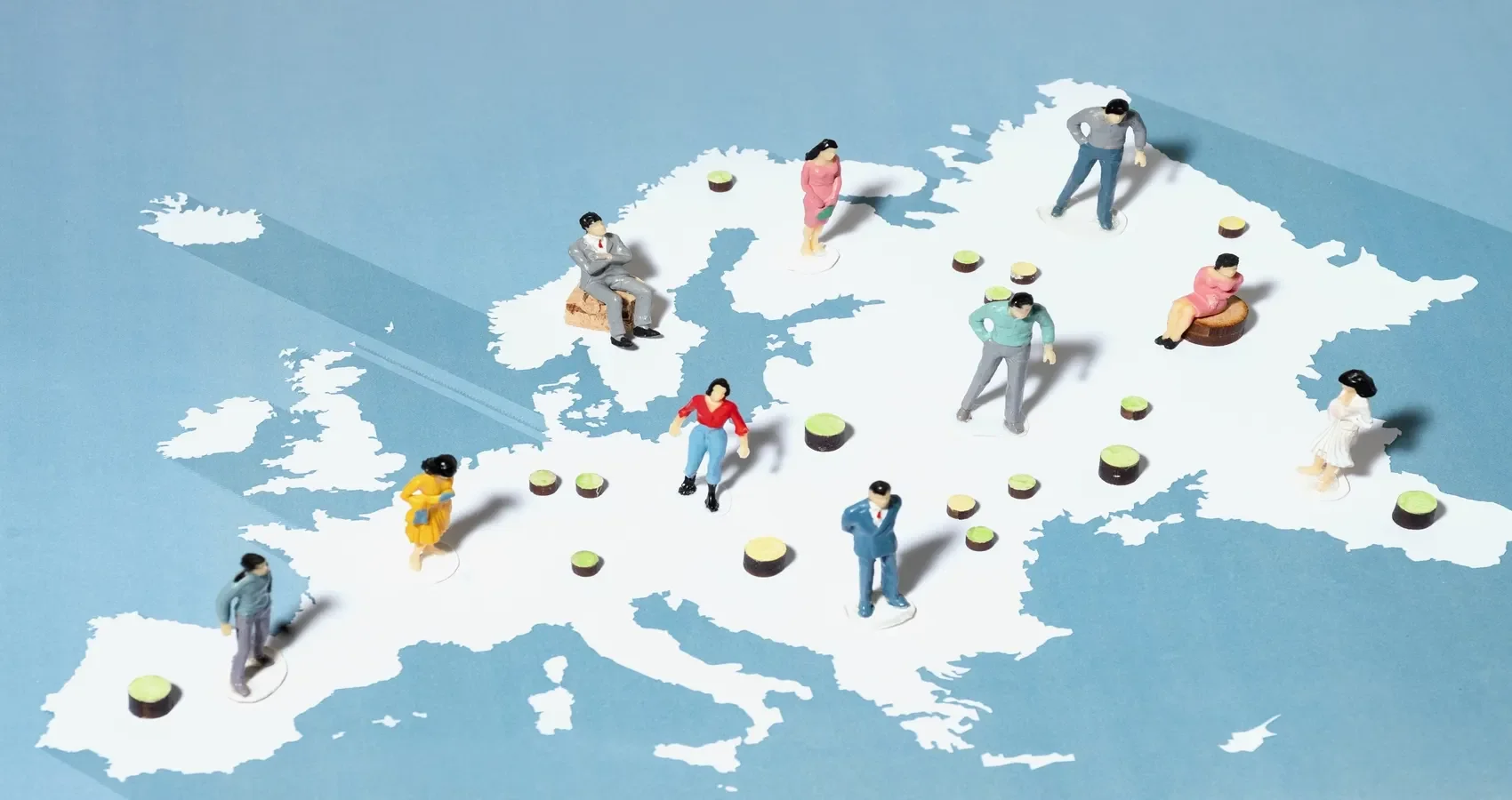
One of the most dangerous misconceptions in business is assuming that because investors have not left, they are satisfied.
Existing capital is sticky.
Factories are difficult to move.
Employees are difficult to relocate.
Buildings cannot simply be sold overnight.
Customer relationships take years to build.
A subsidiary may continue operating for years despite deteriorating economics.
But future capital is different.
The next factory can be built somewhere else.
The next acquisition can happen elsewhere.
The next regional headquarters can be established elsewhere.
The next €50 million can be invested in another market.
Or simply not invested.
This is why the most important capital is often not the capital already committed.
It is the capital that has not yet been committed.
THE COST OF NOT INVESTING
Management often measures the cost of action.
Restructuring costs €5 million.
Closing a plant costs €10 million.
Moving a business unit costs €3 million.
Redundancies cost €2 million.
These numbers are visible.
But the cost of doing nothing is much harder to see.
Lost market share.
Lost productivity.
Lost customers.
Lower margins.
Older equipment.
Slower innovation.
Weakening talent.
Declining competitiveness.
Lost investment opportunities.
By the time these appear clearly in the financial statements, the original strategic decision may have been made years earlier.
The cost of change is visible.
The cost of not changing is often invisible — until it becomes much larger.
INDECISION IS ALSO A DECISION

This is perhaps the most important lesson.
Management often believes that postponing a decision means keeping its options open.
Sometimes it does.
But sometimes waiting is itself a strategic choice.
If competitors invest while you wait, the competitive gap grows.
If costs continue increasing, the economics deteriorate.
If talent leaves, rebuilding becomes harder.
If customers move, winning them back becomes expensive.
If capital costs increase, projects that were viable yesterday may no longer be viable tomorrow.
Waiting is not neutral.
Indecision is also a decision.
THE POLITICAL CYCLE VS. THE INVESTMENT CYCLE

There is another important difference between governments and companies.
Political decisions often operate on a relatively short cycle.
Investment decisions operate on much longer cycles.
A government may think about the next budget.
A company building a factory may think about the next twenty years.
A government may postpone an unpopular decision.
A board cannot indefinitely postpone a deteriorating return on capital.
This creates a structural tension.
The longer an organisation waits to address a structural problem, the more expensive the eventual correction can become.
For companies, the lesson is simple:
Do not wait for certainty before examining a strategic risk.
By the time certainty arrives, the best options may have disappeared.
WHAT SHOULD A CEO DO?
The answer is not automatically to leave.
It is not automatically to cut costs.
It is not automatically to invest more.
It is to reassess the economics.
Five strategic choices usually exist.
1. STAY
The economics remain attractive.
Keep investing.
2. INVEST
The environment may be difficult, but the opportunity is sufficiently attractive to justify additional capital.
Invest selectively and with conviction.
3. WAIT
The fundamentals may still work, but uncertainty is too high.
Delay major commitments while preserving strategic options.
4. DIVERSIFY
Keep the existing business while directing incremental growth toward other markets, products or locations.
This can be particularly powerful when existing capital is difficult to move but future capital is mobile.
5. EXIT
The economics no longer justify the capital employed.
Reduce exposure or leave.
None of these choices is inherently correct.
The correct answer depends on the company.
But the wrong answer is to continue investing simply because that is what the company has always done.
ASK THE QUESTION FROM ZERO
A useful exercise for any CEO or board is to forget the history for a moment.
Imagine the company did not already own its current assets.
Imagine there were no legacy employees.
No historical commitments.
No emotional attachment.
No political pressure.
No sunk costs.
Then ask:
Would we invest in this business today?
If the answer is no, the company has a strategic problem.
The next question is harder:
What would we do if we were building the company from scratch today?
That answer can reveal where the organisation should go next.
THE NEXT EURO MATTERS MORE THAN THE LAST ONE
Strategic management is ultimately about capital allocation.
Where should the next euro go?
Into the existing business?
Into another country?
Into technology?
Into productivity?
Into acquisitions?
Into debt reduction?
Into talent?
Or should it remain uncommitted until the environment becomes clearer?
This question forces management to look forward rather than defend the past.
And this is where the French example becomes relevant.
The issue is not simply the amount of taxation.
It is not simply the amount of debt.
It is not simply the cost of energy.
It is not simply the size of redistribution.
It is the cumulative effect on future choices.
When a system becomes progressively more expensive, more indebted and more difficult to reform, capital allocation becomes increasingly important.
The same is true inside a company.
THE STRATEGIC MIRROR

France does not need to collapse for companies to learn from it.
A company does not need to become loss-making before it needs to change.
The warning signs usually appear earlier.
Margins become thinner.
Investment slows.
Management spends more time protecting existing activities.
The organisation becomes more complex.
Decisions take longer.
Capital becomes less productive.
And eventually, the company discovers that maintaining the existing model has become easier than changing it.
That is the moment when strategy becomes most important.
Not when the crisis arrives.
Before it arrives.
THE STRATEGIC REALITY
Every organisation eventually faces the same fundamental question:
Is the system we have built still the best system for the future we are entering?
For a country, that question concerns taxation, spending, debt, productivity and investment.
For a company, it concerns revenue, costs, capital, people, markets and competitive position.
The scale is different.
The strategic principle is not.
A system can become expensive to maintain long before it becomes impossible to maintain.
That is when leadership matters.
The objective is not to predict exactly what will happen.
It is to recognise when the economics are changing, understand the consequences and make decisions while there are still several good options available.
Because the most dangerous strategic position is not always failure.
Sometimes it is slow deterioration combined with delayed decisions.
And the question every CEO should ask is therefore not:
“Can we continue?”
It is:
“If we were making the decision today, knowing what we know now, would we choose to build the same future?”
That is the strategic mirror.
This article expresses a strategic business perspective and is not tax, legal or investment advice.